How Do You Price Insurance for a Robot? Koop's Sergey Litvinenko
With Sergey Litvinenko (Co-founder and CEO, Koop)
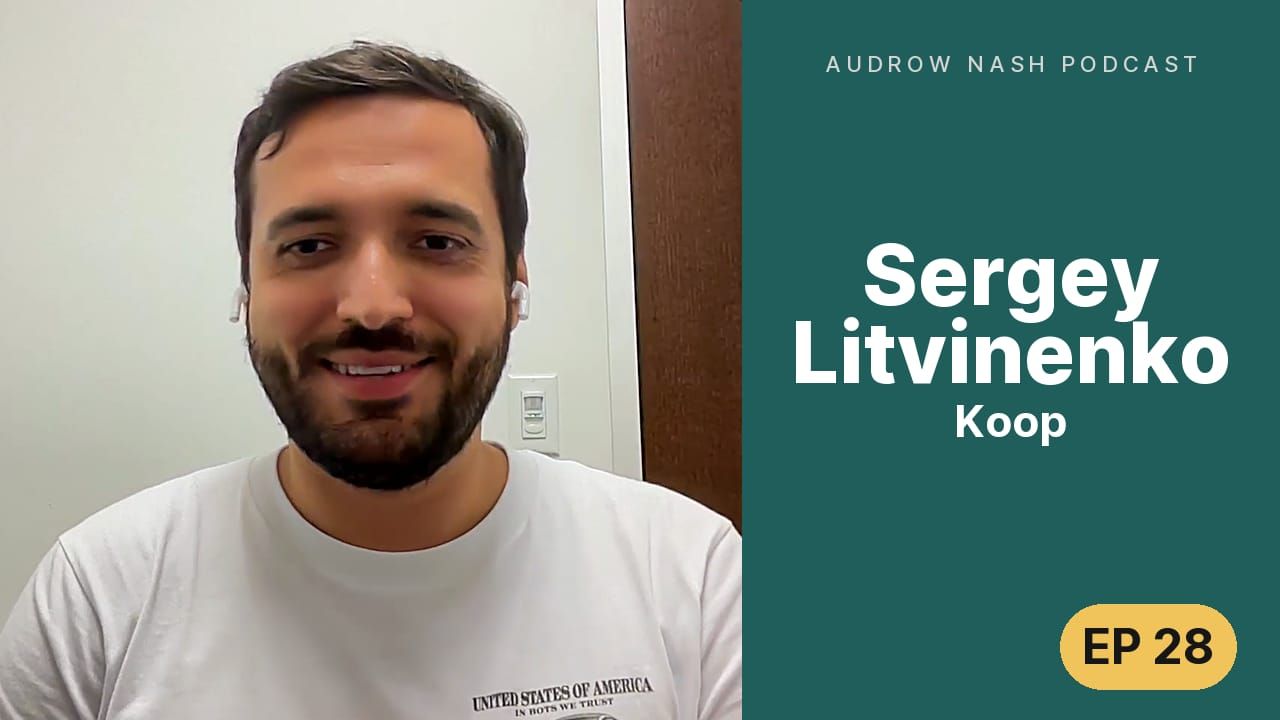
Episode 28 of the Audrow Nash Podcast.
Koop can list every humanoid on a policy like a car in a fleet and price the risk by hours worked instead of miles driven. Koop's In Bots We Trust 2026 report found that what robotics companies pay to insure their robots, per dollar of revenue, fell 69% from 2022 to 2025.
I talk with Sergey Litvinenko, co-founder and CEO of Koop, about how they underwrite and price robot insurance from telemetry, the environment, and safety certifications, why he has high hopes for third-party fleets of robotaxis like Tesla's Cybercab, and what he means by robots becoming an asset class. It's his second time on, after Episode 11.
You'll like this interview if you deploy robots and have to insure them, you work on robot safety or certification, or you follow robotaxis and humanoids as a business. It isn't very technical; how Koop underwrites and prices a robot (3:55–22:53) is the most detailed stretch.
Episode links
- Koop website: koop.ai
- Sergey's LinkedIn: linkedin.com/in/sergey-from-koop
- Sergey's first episode (Episode 11): youtu.be/Dkg2uHhGXao
- In Bots We Trust 2026 report: koop.ai/reports/in-bots-we-trust-report-2026
Chapters
- 0:00 Cold open
- 0:35 Sergey Litvinenko and Koop
- 3:55 Why robots need insurance
- 6:50 What underwriting decides
- 10:27 How Koop prices a robot
- 13:21 Hours, not miles, for robots
- 17:12 Getting data from robots
- 20:49 Software updates and test deployments
- 22:53 Ten people, nearly instant quotes
- 25:20 How Koop uses AI and Claude Code
- 31:50 Safety certifications and EU regulation
- 36:18 Do certifications mean fewer claims?
- 41:04 How fast robotics is growing
- 46:04 Tesla Cybercab, Waymo, and fleets
- 49:20 Owning a robotaxi vs. owning a home
- 52:53 The In Bots We Trust report
- 55:17 Measured growth and the enterprise bottleneck
- 59:57 Funding a robotics startup
- 1:05:07 Humanoid rentals, grants, and prepaid pilots
- 1:08:32 Where humanoids will work first
- 1:14:40 Cyber risk and hacked robots
- 1:20:59 Insuring AI agents
- 1:24:01 Cyber and errors and omissions coverage
- 1:28:39 Robots as an asset class
- 1:33:38 The next three to five years
Audrow Nash Podcast Newsletter
I send one email when a new episode is out: who I talked with, what they're building, and the technical or business takeaways I'm still thinking about a day later, plus the YouTube link.
Or subscribe on Buttondown directly: buttondown.com/audrow
Click any line to jump the video to that moment. Machine transcribed and lightly cleaned, so expect some errors. Transcript on its own page, plain text, WebVTT, SRT.
0:00 Cold open
Sergey Litvinenko Koop is an insurance platform for robots and autonomous vehicles. Robot insurance. Sounds a little bit bizarre to some people. I mean, robots are supposed to be perfect. They're not going to make any mistakes. That's not true. This is going to be the first time in the human history where robots will become like a daily occurrence to millions of people, I think autonomous vehicle ownership is going to compete with like home ownership.
Audrow Nash You said robots are becoming an asset class. Tell me more about that.
Sergey Litvinenko Two parts to the answer.
0:35 Sergey Litvinenko and Koop
Audrow Nash Alright, hi Sergey, would you introduce yourself?
Sergey Litvinenko Hey, Audrow, this is Sergey from Koop here, joining you for the second time.
Audrow Nash Yeah, hell yeah. Excited to talk again, it's been quite some time. Tell me about Koop, just for those who aren't familiar, what do you guys do? And then I'd love some company details too, like funding and how large you guys are, where you're based, these kinds of things.
Sergey Litvinenko For sure. Koop is an insurance platform for robots and autonomous vehicles. We work with all kinds of use cases from robot arms and traditional industrial robots to mobile robots that you can see on the streets, to drones, to self-driving cars, and all kinds of automated equipment like agriculture, bulldozers, construction, all of that stuff. It's a really exciting journey because we get to see lots of stuff that's happening within robotics and actually put money to it. So we act as an underwriter and we price the insurance that we underwrite. So we see lots of things happening behind the scenes. We've been at it since 2021 and based in New York City, a team of 10 people keeping it very efficient. And we raised two rounds of funding, pre-seed and a seed. Thank
Audrow Nash I think from I'd like to get into kind of like how it all works. I'm impressed you guys are such a small team. because like you have a report that you came out with. You're insuring a lot of the robotics industry. but I guess one of the things that strikes me with what you're saying now, I don't know if you had as much of an autonomous vehicles focus. Is that new? Or Has that been kind of one of the things you guys have been doing all along, or are you like associated with Tesla insurance or anything else? I see your shirt with the Tesla on it.
Sergey Litvinenko You. Yeah, Ha yeah. we are not associated with Tesla, but it's not stopping us from insuring autonomous vehicles. I can talk more about Cybercabs in particular a little bit later.
Audrow Nash Cool.
Sergey Litvinenko When we started the company, we focused on robotics in general. We look at robots as an emerging asset class, as an emerging risk class, and we wanted to be use case and vehicle type agnostic. And we worked with a few autonomous vehicle companies. We still work with them. And it happened to be that the growth in non-public growth use cases was much higher,
Audrow Nash Oh, yeah.
Sergey Litvinenko Partly because of liability, because when you are on a public road and you get into an accident, it could be a very challenging situation. And when you are in a constrained environment, it becomes a lot simpler. So if you look at our customer growth, the non-public road customers were just much higher growth than public road customers. But I think that's going to change in the near future. And that's where Cybercabs come into the picture. Not only Cybercabs, there are also Waymos and other players that are coming up in the US. But I think autonomous vehicles are about to finally have their moment and hoping Koop will see exciting growth coming from that area as well.
3:55 Why robots need insurance
Audrow Nash Cool. Very exciting. Yeah, I want to talk about that quite a bit. So, give me a high-level perspective of how it works. What I remember from last time is you have a good way of logging behavior of the robots, and then you use that to assess risk and failure modes and things like that, and you use that to underwrite it to figure out how much risk is involved for any robot so that you can make, like, insurance, figure out how much you have to charge them for insurance. So, it's a good bet for you, and they feel covered in this kind of thing. But tell me about the process more, like, I guess, how does it all work, and how do you guys service the robotics industry?
Sergey Litvinenko Of course. Two parts to answer that question. First, why do you even need this whole thing in the first place? Robot insurance. Sounds a little bit bizarre to some people. I mean, robots are supposed to be perfect. They're not going to make any mistakes. That's not true.
Audrow Nash Love it. Yeah, yeah. Mm-hmm.
Sergey Litvinenko You buy robot insurance for two reasons. Number one, when you have a deployment, liability is written into the deployment contract and insurance is usually a big part of it. So your customer wants you to buy insurance. So if something goes wrong, there is somebody paying for that. And they don't want to be the ones paying for that. That's the first thing. And the second thing, because you just want to protect yourself, you as the robotics developer operator, in case, let's say you have thousands of robots and you get into an accident and there is a lawsuit, insurance protects you from liability. So it's contractually imposed. And also it's like management or board mandate that you have to have. Those are the two reasons why people buy it. So how do you actually price the robot insurance? That's a great question. I'll tell you that at the end of the day, when a robotics company buys an insurance product from Koop, it looks like a policy that has many different pages. And that's what essentially you're paying for. And the way we construct that policy and rate that policy is unique to our underwriting and pricing process. So when it comes to underwriting is all about saying, hey, if robotics company comes to me, should I back it? Should I back it with my insurance product? So something goes wrong, I'm going to pay for that. And we'll do it algorithmically, meaning that we have a model where we collect certain inputs from the company, and then it spits out whether this risk is acceptable or not acceptable with certain conditions. There is also some human judgment involved in situations where maybe the model is lacking some data. It could be some exotic use case like autonomous nuclear submarines. Not a lot of data about that. So you have to involve human underwriters. And then once you pass the underwriting, you have to do pricing. And pricing actually tells you, OK, how much should we charge this company? Yeah.
6:50 What underwriting decides
Audrow Nash And just explicitly, what is the output of underwriting? Like, I'm not that familiar with insurance, and I suspect some people are not. And I know this is your day-to-day walk, but what is underwriting? What is the function of it?
Sergey Litvinenko It's very simple. Underwriting is all about evaluating the risk and saying whether we want to cover that risk or not. You actually encounter underwriting all the time. Let's say you want to mortgage. You have to go through underwriting. You open a credit card. You go through underwriting, get a car loan. You go through underwriting. Similar thing. You have to provide Koop with some information so we can make a decision whether we want to cover you or not. And that's the whole underwriting process. The end result of that--
Audrow Nash Mm-hmm. For everything. Yeah. Mm-hmm. And it's basically, it's gonna be a ratio of how much you can charge and how much you expect to pay out, this kind of thing. Is it? Because you're saying an incident could be this expensive, but it's this likely, and you have to make sure that it makes financial sense for you all to be involved with. Is that correct?
Sergey Litvinenko That's more in pricing what you're describing.
Audrow Nash Ah, okay.
Sergey Litvinenko You are talking about the actuarial model that says, for the customer that we are able to cover within our rule set, how much we should charge them versus how much insurance they're buying.
Audrow Nash Yeah, it's not pricing yet. We're not there yet. But you're seeing if it's a good bet effectively for you all to be involved with, or, like, what is the output of underwriting, I suppose.
Sergey Litvinenko Yeah. In our use case-- sorry, in the way we build our model, it pretty much spits out whether this is acceptable, whether this risk is declined, or it's accepted with certain conditions. So it's literally-- that's what the platform spits out. And the way the platform evaluates this is primarily-- it's both on quantitative and non-quantitative data. So we could look at some data coming from the API, maybe coming from the documents that they provide, the customers I mean, but would also look at the use case. For example, if we're working with drones, we would also look at how the drone segment performs and maybe what particular things they're hauling or what particular
Audrow Nash Mm-hmm.
Sergey Litvinenko Missions they're on. And there are rules built in that, hey, if you are doing, let's say, anything too dangerous, we would decline this for certain reasons. I'll give an example like areas where we have either very high conditions or like nearly automated declinations would be medical robots, surgical robots.
Audrow Nash Oh, interesting.
Sergey Litvinenko Yeah, the reason being there is that it's not even about the robot itself, it's more about the medical practice, is that it's highly regulated. And as a result, a mistake can cost a lot of money, including lots of litigation. So unless the robot has like tons of data that is like nearly perfect, which none of the robotics companies that we encountered in that space have, we decided to pass just because if a robot makes a mistake and everybody gets sued. So our underwriting is built around this knowledge of how liability works within different pockets of robotics deployments. And then it spits out a decision and say, hey, this is acceptable, this is not acceptable or acceptable with conditions. And then there is pricing. And pricing says, okay, how much should we charge for this risk based on the inputs that we have? And that's where it's all quantitative. And we look at robotics risks through the standardized model. That means that we can compare one risk against the other, or we can develop the baselines, which is what the In Bots We Trust report was all about.
Audrow Nash Yeah. Mm-hmm.
10:27 How Koop prices a robot
Sergey Litvinenko And then we say, okay, we're going to look at the risk performance, which primarily comes from the robot telemetry, we're going to look at the environment that they operate in. So we know how close they are to other people's property or other humans on a job. And then we're going to look at your safety and security certifications. And those three things get encoded into the final rate that our customers pay. And that rate could be either at the company level, it could be at the deployment level, it could be at the individual robot level.
Audrow Nash So cool.
Sergey Litvinenko So for example, you come to me,
Audrow Nash That's so cool you can do it at the robot level. So cool.
Sergey Litvinenko Yeah, I'll give you an example. Well, humanoids are a thing right now. Everybody's talking about them, hoping to see lots of deployments next year. Today, we can, a humanoid company can come to Koop, and we're going to issue a humanoid coverage on a per humanoid basis. We're going to list every single humanoid like it's a fleet of cars, and you'll be able to track the rate for each, even if it's across different customer sites. So
Audrow Nash Mm-hmm. It's amazing.
Sergey Litvinenko It becomes it becomes very, it's just very cool to open your insurance policy and see a fleet of robots in there. That's where that's where we had it. And we just, you know, very glad to be at the forefront of it, you know.
Audrow Nash Yeah. Tell me about, so is there any, like it's a, I don't know, like we have a Tesla and the Tesla has Tesla insurance and one of the things that I think is so cool is it adjusts our premium month to month based on how well we've been driving by its estimate. Is there anything that makes estimating on a like robot by robot level, like instead of a fleet level or a company level or whatever, is there anything that makes it harder? Like, is that more of a challenge? I imagine like a lot of the traditional, like a lot of the other automotive companies, they do it by the year and they look at a lot of like demographic info on you and your past driving record and things like that. But it's just so interesting to have very fine resolution to individual entities to insure. Like, I guess it's more of a data problem and if you solve the data problem then it's not intrinsically more difficult than anything else. Or tell me about going to the like single entity level and the challenges there.
Sergey Litvinenko Yeah, yeah, it's called unit of exposure. When you drive your Tesla, each mile that you drive is a unit of exposure. So theoretically, each mile that you go, an accident can happen, right? in So if you are operating, if you have a wheeled use case, let's say self-driving cars, mileage is a perfect unit of exposure. That's why we do this and other people do that too. In robots, it becomes a little bit different because, sure, mileage is one thing, but if you deploy humanoid, let's say, humanoid, like the their mileage is kind of useless, right? But
13:21 Hours, not miles, for robots
Audrow Nash Mileage is just kind of irrelevant. Mm-hmm.
Sergey Litvinenko What's important for humanoids, it would be how many hours they're in service and how many jobs they perform, yeah, exactly. So for
Audrow Nash Yeah, operating time. Mm-hmm.
Sergey Litvinenko Lots of those non-public road use cases, we track hours.
Audrow Nash Cool.
Sergey Litvinenko And then based on those hours, you are able to estimate how much you charge for the risk. And it really depends, I'll tell you that we have two models. We can do hourly model, we can do non-hourly model, you can kind of convert one.
Audrow Nash What are the models? I'm sorry, I missed it. You can do what model or what model?
Sergey Litvinenko I mean, when we calculate the rate for robot deployments, we can do an hourly model where you, as a robotics company, you come and tell us, hey, we're gonna have this many robots estimated to perform this many jobs, running this many hours, and we can use that to develop a rate, like per hour rate, and then the more hours you perform, the more you're gonna pay. Alternatively, we can do it in a prepaid fashion, like, okay, here is a rough estimate, but we're not gonna charge you on a, let's say, monthly basis, you just prepaid for the whole thing and off you go. But we are in a world where
Audrow Nash Oh, hourly, yeah, yeah. Mm-hmm. That's really cool.
Sergey Litvinenko AI is replacing physical work. Physical work is measured through the number of jobs you complete, the output you produce, but for insurance purposes, usually hourly based. And that's what we use as exposure of unit.
Audrow Nash Mm-hmm. Very cool. I like moving to such a granular perspective because it's like, it almost approaches, it makes physical work approach like API usage kind of thing where you pay actually by the, yeah, yeah, yeah. But it's just, it's so interesting because it's so efficient because you pay what you're using
Sergey Litvinenko That's a good comparison.
Audrow Nash And it, and also if you are getting paid per hour with your robots it's very nice if your insurance costs scale linearly with your usage. Like, that's very efficient, not a lot of waste, this kind of thing. Super, super cool.
Sergey Litvinenko Quick comment here. We also look into the digital AI world because the way those models perform for digital tasks is very interesting. In the physical world, it's much more complicated. But,
Audrow Nash Do you mean like, Grok or other, do you mean like, AI agents for doing stuff or what do you mean?
Sergey Litvinenko Yeah, exactly. So AI agents, but let's say so people measure AI agents through tokens. How much tokens they consume and what kind of, how many tokens they produce and how much it costs. It's probably gonna be like the comparison here is that, okay, in the physical world,
Audrow Nash Oh, that's so cool. Mm-hmm. Yep.
Sergey Litvinenko People will track hours and useful output per hour. So it's gonna be similar to the digital world and I think it's just exciting to think that there is some commonality between those two things.
Audrow Nash Convergence. Mm.
Sergey Litvinenko Still a long way to go, but maybe AI eventually is just gonna be not digital AI, physical AI, it's just AI.
Audrow Nash Hahaha That'd be so cool. Yeah, what a thing that'll be. Okay, hell yeah. So then, so we underwrite it, yes or no decision, do we move on? Then we price it, what's a fair cost for the risk of covering? And then how do you get data from robots to understand their behavior? How do you deal with upgrades and changing behavior for the robots? How does all this how does all this fit in? Like, where, how does this work, I guess?
17:12 Getting data from robots
Sergey Litvinenko The most valuable data comes from the API. So we can hook up to, it really depends on a customer, but usually customers have a place where all the data goes to. And they can let us access part of the data that we tell them over an API. So whenever let's say they have a deployment and then they send the data to the cloud, whenever they do that, part of the data hits us. And then we can see how on a robot by robot basis, what kind of usage they're doing and what kind of behavior they're doing, okay? And within the behavior, we're really looking at things that are could indicate some problematic behavior. It could be safe stops, it could be unusual behavior that would derive based on telemetry where the vehicle accelerated, decelerated or robot accelerated, decelerated or turned improperly. And when you look at a lot of data, there are some of those corner cases that you can catch. And that data is very useful because it gives you lots of precision in terms of what's happening. And then as you gain enough knowledge, you can see how it shapes up by different use cases. For example, autonomous mobile robots, AMRs deployed within industrial facilities is our most popular use case. And there you can see how those AMRs behave themselves across different sites, across different deployment types and scale as well. So that's the first thing. And then that thing can be supplemented with anything that customers might send us. They might send us some additional files with data, maybe that was not available over API, they just throw it to us and we take it from there.
Audrow Nash Awesome. Huh.
Sergey Litvinenko The second part is the environment. We have a certain way how we encode the environment is that it primarily comes through a pretty detailed survey that we receive from the customer. A customer gives us lots of details about where they're gonna deploy the robot. And then all of that gets translated into the certain parameters and variables within that equation that we built. And then the final thing is certifications. It's safety and security certifications. We love seeing robot safety certifications, be that functional safety, be that mobile robot safety, which I think ISO has something coming up, also on the humanoid side. And also company-wide safety standards, especially around cyber. So when you combine all of that, it's like one giant equation. It spits out the rate that we should charge the company and then as deployments change or the nature changes, let's say the robot data changes, the environment changes, or the certification changes, that's what drives the rate.
Audrow Nash Mm-hmm. Hmm. Very cool. I wonder. I feel like we have so many interesting things to talk about with AI, with cyber. What a crazy thing. But with this approach, if you see the behavior of the robots changing, more errors in a certain way after some update, you can identify that the errors have happened and maybe something's different and then revisit your risk and then change the rate on them. Like, one thing, a while ago with the Tesla, it was like when updates would roll out, for a few days, the autonomous driving wasn't as good. Seems to, we don't notice it now, but it was funny because it was like, "What the hell did it do?" And it'd be like, "Oh, we just recently updated." And I guess you could probably see that with other robots too. So yeah, you can look for regressions in behavior because you have the telemetry data and things like this.
20:49 Software updates and test deployments
Sergey Litvinenko That is correct.
Audrow Nash Very interesting.
Sergey Litvinenko Also one thing, not only tracking the software releases and then performance after the software release, but sometimes customers run two types of deployments. There's a test or R&D deployment and there is a production deployment. And then in the test deployment, you see all kinds of crazy stuff because people put this thing to use to test, right? And we actually,
Audrow Nash Yeah. So you can insure those differently
Sergey Litvinenko Yeah, and actually we do not, I mean, people do want to insure their R&D deployments, but they are pretty cheap compared to production deployments. Because the worst thing that can happen in the R&D deployment is that
Audrow Nash With this. So cool.
Sergey Litvinenko There's gonna be very limited outside liability to the company, right? And you probably do that under specific constraints, maybe in specific places. But in production, it's real humans, it's third parties, and that's what drives the rate. So we are also able to separate pricing by deployment, test versus production, which people appreciate because it makes sense to them that, well, why should I pay bad rate for something that's supposed to behave badly because I put it to test?
22:53 Ten people, nearly instant quotes
Audrow Nash Yeah. That makes sense. Man, I love the granularity that you're able to do. That's so incredible. One thing that really strikes me, especially with you all being a team of 10 people, the variation that you must see and like, "Okay, this one company that you're insuring, you get their API data this one way, this other company you get it a different way, then they just dump some data on you that's useful for things, all the different certifications, all the different just... It's so high mix in some sense. Tell me a bit about that because that is a very interesting thing that I assume is a big challenge. Mm-hmm.
Sergey Litvinenko Mm-hm. Well, in order, so just to put it into the perspective, over the past few years, I think we've touched, by touched, I mean, insured
Audrow Nash Insured.
Sergey Litvinenko And pay claims for 20 to 25% of the US robotics companies by count.
Audrow Nash It's incredible. Thank you.
Sergey Litvinenko So fourth of the market. And that's what gave us the ability to create this report. And I can tell you that when we started Koop, lots of things were done by hand. But now everything, almost everything is automated. And by automated, I mean the data intake, the data analysis, the underwriting part, and the pricing part. The only thing that requires human input would be the claims, because depending on who's involved, you might have to deal with like five, six different parties at a time. And that requires manual communication over email and phone. But everything else is automated. Now, if let's say we give an API to the company, and they're unable to hook it up, and they just dump the data, we develop the data analysis pipeline, where it just takes whatever files we have and puts them into the right format that we need for the model to take it in.
Audrow Nash Mm-hmm. Hmm. Buckets. Mm-hmm.
Sergey Litvinenko So that's why each customer that comes into Koop could be underwritten and priced nearly instantly. And if 10 customers come to Koop after this interview, I'll be able to do them in 10 minutes. So
Audrow Nash That's amazing.
Sergey Litvinenko Just one by one. We do have human in a loop, so we review what the machine speeds out. But we do not have to actually do analysis by hand.
Audrow Nash Hell yeah. Yep. Huh. Yes. How much efficiency gain have you gotten from all of the LLMs,
25:20 How Koop uses AI and Claude Code
Sergey Litvinenko The why efficiency.
Audrow Nash Different AI models and whatnot? Like, do you guys use Claude Code for everything? Or like, do you have... Just tell me about how AI has changed stuff for you and if you're using it and everything.
Sergey Litvinenko It has been magical. I'm pretty sure our experience is similar to yours and the rest of the industry is that the velocity, it's like, you know, vibe coding has bad connotation to it. But I think when you do it correctly, it's like the secret weapon that you wish you only had. We both increase the velocity of the product development, especially with some recent changes that we made and the quality of the product. By product, I mean the platform. Okay.
Audrow Nash Nice. Mm-hmm.
Sergey Litvinenko The insurance product itself, like the huge piece of paper, also has gotten much more dynamic because now we can almost algorithmically change parts of the coverage depending on what the customers are seeking.
Audrow Nash So cool. Mm-hmm.
Sergey Litvinenko And same applies to the rate. If a customer comes and we need to adjust the rate outside of our pre-existing boundaries, it can be done with a couple of clicks. So on the back end, so whatever the customers are not seeing, it's been dramatic improvement. And now that we're able to spit out the insurance products and quotes really fast, people like that. They're like, oh, I would rather work with Koop to get this whole thing done in a couple of hours than work with another carrier that's gonna get it done in weeks, sometimes months.
Audrow Nash For months. Mm-hmm. Oh, yeah, yeah. Crazy. Man, what a cool thing. Yeah, it is...
Sergey Litvinenko How about you? Are you on the same page, AI good for you?
Audrow Nash Oh, yeah, amazing. I think it's the best time to be a builder. Like, anyone who makes stuff, just incredible now. I don't know, for everything, too. It's like, it's wild. I always... I'm like, throwing whatever I can at it to see if it does well with it. And some of the things that have been too hard in the past, like, Opus 5.5 is now able to do. Like, it's just so wild. It's such a cool time.
Sergey Litvinenko Mm-hmm. A hundred percent.
Audrow Nash Uh-huh. How... So, do you... I guess you can use AI very effectively to kind of build systems to automate things. You can maybe use it for some of the judgments that you're doing about, like, put this here, put this here. Like, tell me about some of the specific ways you're using AI in your whole platform, I suppose. Like, how are you guys actually using it specifically?
Sergey Litvinenko Yeah, so a part of the data intake and analysis would be a good example. Whenever customers are not using the API and they literally just throw whatever they have at us, the AI... We have built a pipeline that takes all the data and then reads through the whole thing and then finds what we were looking for and formats in a way that's compatible with the rating model.
Audrow Nash Mm-hmm. Hell yeah. Yeah, that's such a good use case for it. Where you can find the specific things to fill them in. That feels like, even for a while now, like, I don't know, a year or two years, something like that. Finding the parts to fill in, to make it... Like, doing the interfacing? It's been phenomenal. That's such a great idea.
Sergey Litvinenko Previously you had 100%. And Mm-hmm. And I got to tell you the data ingestion pipeline that we built where you transform whatever you've been given into the format that you need, that itself could be a company, like a separate company. I'm pretty sure somebody's already working on it. So that has been the game changer. That's probably a year ago.
Audrow Nash Oh, I'm sure. I have a friend working on something similar. Yeah, yeah.
Sergey Litvinenko So that part has been probably the best efficiency gain for us by far. There is another cool feature that we have where we actually turn your deployment contract language into the specific tasks and control you need to do in order to make sure everything is in a good shape. I'll give an example. So let's say you are deploying with an enterprise and most likely that enterprise has a procurement department that wants you to do things in a certain way. So they send you a contract and then contract has like a... it's like an operating agreement. I'll give an example like if you are maybe deploying on some network, your robots, that network will send you the agreement that you have to operate by. And I mean historically people used to do it. They would take like a Sharpie and they would take the piece of paper and just go and you know mark everything. But we built a pipeline where
Audrow Nash Oh, so tedious, yeah.
Sergey Litvinenko Our system analyzes the whole agreement, understands different clauses, then organizes them and then looks for the existing controls that you have on a platform, links them up together and automatically tells you, "Hey, you're already meeting let's say 50 out of the 60 controls and here are the 10 requirements you need to pay attention to." And that way you like know exactly what you need to be focused on. That comes from our compliance module which we now have in addition to insurance. But people like that because I mean you hook up Koop with Claude MCP, you upload that contract to your Claude and roughly in a couple of minutes you're going to know exactly what you're missing and then you can assign that to the people on your team and off you go. Without AI it would have taken you weeks
Audrow Nash Mm-hmm. Cool. Mm-hmm. Forever.
Sergey Litvinenko To get it done. Like literally weeks.
Audrow Nash And you'd have your expert on it, and it's just, what a thing. Yeah, it blows my mind how, Just how much things have changed with that kind of thing. Because they're... It's like... That was a whole... Like, you would study it and work on it, and have the whole thing in your head forever to go mark all the things, and that would take forever. To link them up to requirements, to the contract, and everything. Just... And now it does it in, like, minutes. This kind of thing. Just so crazy. That seems like a really good use case, too. Yeah, I think finding relationships between different data in different places is just phenomenal. Very cool. Hell yeah. Now, Has it helped? I guess has AI helped with... Like, it strikes me... Certifications are detailed. I haven't been too involved with much for certifications, but I've done some, like... I don't know... Simple certification trainings for some of the space work I was doing when Open Robotics was doing it. And, They're long. There's a lot to know. There's a... Like, people study the specifications and everything. You being in a bunch of different industries, it's like you have all these reports. They're iterating and changing over time. I assume AI is very helpful for staying on top of that, too, and seeing how you have to relate the new certification to... Tell me about that. Tell me about the certification space. And just, like, keeping up with all the changing regulation around... Well, everything.
31:50 Safety certifications and EU regulation
Sergey Litvinenko Mm-hmm. Yeah. Certifications are very important in our underwriting process because not even the fact that you have all those controls in place, but the fact that your company as the organization made this investment and now has everybody operating under certain principles. That's really important because, you know, lots of people don't realize that you can have, you know, even the safest robot out there, and then somebody hacks your email and gets access to your system, and then the whole thing goes down. The trouble comes from the places you expect least. I mean, that's why hackers are still hacking because they keep finding new vulnerabilities.
Audrow Nash Mm-hmm. Mm... Yeah. Mm-hmm.
Sergey Litvinenko And certifications is probably the best way how to try to protect yourself holistically.
Audrow Nash Cool. I like that approach. Or that way of looking at it.
Sergey Litvinenko We are a big fan of robot safety. We believe that there are standards out there that have a lot of credibility like ISO 10218 or what is it, R15.08. Those have great adoption, great reputation. So whenever a customer has those, we definitely mine those for the controls that we're interested in for the underwriting. But even if you have that certification, you get like an automated discount, okay, because we already know
Audrow Nash Mm-hmm.
Sergey Litvinenko What they have. So that definitely helps. That saves money. Also, it might help with underwriting if, let's say, you are a, I would say, conditional use case that we are on the fence about, but you have a certification in place, we will say yes, okay. So certifications are helping with both pricing and underwriting.
Audrow Nash Cool. Mm-hmm.
Sergey Litvinenko Something that we're interested in, I think, so there is a lots of rumors about what's going to happen with digital AI regulations. They're trying to do some federal stuff. I mean, we'll see what happens. I definitely think the physical AI world will not be able to escape regulations. You'll have to do them. And a great example is obviously European Union, EU. I think starting January 2027, they plan to introduce EU machinery regulation. I haven't read the body of the regulation yet, but the premise is that any machine that runs any kind of machine learning where the machine can perform any task or a job using any kind of algorithm will have to be certified. And I think that's a sign where everything is going, is that these machines, robots, especially robots running any kind of neural nets, will have to pass some form of certification in order to get into the, I mean, probably will not be needed for pilots, but for production and scale 100%. And I'm watching closely how well the EU regulation will be taken. I hope it will be taken in favorably, but don't forget it's also a burden for the companies developing those robots. And that's where hopefully we'll be able to help by making it easier and trying to save them money via insurance. That's the way to recoup their investment.
36:18 Do certifications mean fewer claims?
Audrow Nash Interesting. What's your read on it? Do you think it will help? Do you think it will... I mean, I've talked to founders where they're just going to skip Europe because of the regulations for this kind of thing. More regulations probably makes it even harder for this. What is your... What's your take on it? Do you think it will go favorably, as you've said? And by favorably, do you mean that entrepreneurs will accept the burden of the certifications and then they proceed that way and the market kind of stays safe for this kind of thing?
Sergey Litvinenko So first of all, if you look at our, like, do those things matter? If you look at our data that we shared within the In Bots We Trust Report, companies that have some form of safety control, safety plan and certifications, experience less claims. So I mean, we don't have...
Audrow Nash Is it causality, do you think? Do you think it's causal or... Like, I wonder if it's just like they're better run, therefore they have these certifications, therefore they have fewer claims? Or do you think it's... I don't know, it's like that whole military thing where it's like a ship that has the little details polished, has all its maintenance sorted out, this kind of thing. Do you think it could be similar to that?
Sergey Litvinenko Probably, I think so. I think so, yeah. If you are able to achieve a robot safety certification, you probably have everything else in order. Yep. So it might not be fair to attribute this just to the certification,
Audrow Nash Everything else taken care of?
Sergey Litvinenko But if you run the numbers and you look at the companies that had accidents, that didn't have accidents, the ones that didn't have accidents had certifications in place.
Audrow Nash Yeah. And also, from your perspective, as an insurance company, it doesn't matter what's causal. You kind of want to lump people into the like the lowest risk from your perspective as possible. You don't necessarily care about causality as... Like, it's too hard to find, it's too many resources to find, it's not worth it. But you see it as just better if these companies have this certification because in your observation, these companies have fewer claims, this kind of thing. Is that correct?
Sergey Litvinenko Correct. We look at the evidence, at the real world experience, and if the experience tells us that that's working, we update our priors and we incorporate that. Obviously, statistical significance is the thing, and I would like to test that on all the robotics companies globally, but I think, you know, our sample size is getting there. I think we'll get to statistical significance soon.
Audrow Nash Yeah. But it also... The thing that's interesting is it really doesn't matter. Like, for an organization that's doing insurance, like for Koop, you are navigating so many complex spaces. You're going to pick up on things that increase or decrease risk. And just... If you find that there's a p-value, like a small p-value, and it ends up reducing the likelihood of claims and things, then it's a good thing to do.
Sergey Litvinenko Exactly.
Audrow Nash Just... Like, it's like... You move up a level of abstraction, you don't worry about causality, and you say, "Across the board, we see these things." And that's how we make our determinations.
Sergey Litvinenko Yep, Mm-hmm. Yep, that's what insurance is all about. Exactly.
Audrow Nash Yeah. It's cool. It's
Sergey Litvinenko You see, you're becoming an insurance guy with me.
Audrow Nash I feel like it's a space that most people don't find interesting, I think, but it's very interesting. It's like once you start to
Sergey Litvinenko Mm-hmm. Yeah.
Audrow Nash See the details of it, it's really cool work you're doing, and you're enabling so much to happen by doing this work that most people wouldn't consider. Which is just wonderful.
Sergey Litvinenko You know, Warren Buffett made a fortune on GEICO. That was his big thing, and he realized that insurance was an attractive business. I really hope that in the 21st century, it's going to be a similar story, with robot insurance, when you start shipping billions of those things, and you have to financially protect them. Not only them, but also humans around them, and I think it's a revolution. It's going to be fun.
Audrow Nash Yeah. Mm-hmm. Yeah. And especially if there are billions of robots out there, like, you guys are in such a good position to ride that whole wave, too. So if Tesla does deliver on making a million humanoids, or whatever by some date, or figure, or any companies, even if it's just autonomous mobile robots, it's like you ride that wave, which is excellent.
Sergey Litvinenko Mm-hmm.
41:04 How fast robotics is growing
Audrow Nash What do you think... Like... I guess, what's your, Where do you think it's... Like, I guess... What do you think the rate of growth is for this? I'm sure that you all, having 25% of the market, are... I mean, that's incredible growth for you all. But then you're looking at the total addressable market growing. Like, what do you see about the robotics space in general?
Sergey Litvinenko Well, to begin with, robots is a small market. if you Even if you loop in drones and industrial robots, still a small market. In the U.S., you can probably track anywhere between 800 to 1200 robotics companies. In China, there is more, but in China, there are lots of parts manufacturers, okay? So, the ecosystem is still early. I would say, well, it's fair to say that Koop is a function of that industry. So, we are going to be a derivative, and if the industry goes through the roof and becomes like multi-trillion dollar, which I think it eventually will, we're going to follow that. In the meantime, we're just gaining market share. That's what we're doing.
Audrow Nash Yep. Mm-hmm. Hell yeah. Yep. Because you have the two hills to climb. You have the pie getting bigger overall, but then you have growing
Sergey Litvinenko And, yeah.
Audrow Nash Part... You have a growing part of that existing market, which is quite cool.
Sergey Litvinenko Yeah. I think one... So, historically, if you look back, robots grew in places that you didn't see or didn't hear about. It's factories, you know? So, if you go about your daily life, you don't really see the robots. I think, starting probably next year, we're going to see... This is going to be the first time in the human history where robots will become like a daily occurrence to millions of people, and that's not going to be through humanoids just yet. Humanoids right now are still at the demo stage. It's going to be through self-driving cars.
Audrow Nash Mm-hmm. Mm.
Sergey Litvinenko Right now, you go to SF to Austin, they're everywhere, and I think Waymo and Tesla are about to flood this market with their CapEx money, and that's going to be the first time in human history where robots are going to be as easy as getting a latte at Starbucks. You know? It's going to be like normal.
Audrow Nash Yeah, probably true.
Sergey Litvinenko And I'm super excited about this. I think that's going to be the moment when we'll see other form factors come through the door as well, delivery robots, drones, humanoids, and we'll see what else we'll get.
Audrow Nash Mm-hmm. Yeah, it's a really cool time. I do feel like we're on the cusp of everything. And it's also like... It was coming. Like, it was feeling inevitable five years ago. Like, it's coming. It's getting there. But I feel like with AI, it's coming so much faster. And with all the emphasis on compute and things like this, so people can get good dynamic models of robots and things like this. And maybe some, like, I don't know, language action models or vision, whatever, action models. It's coming faster, which is really, really cool. Let's see. Do you have any guess on, like, growth percentage per year kind of thing? Or, like, I'm sure you look at your total addressable market and whatnot. Do you have any thoughts about that or any, like, any concrete feelings on where the market's going?
Sergey Litvinenko Yeah, well, in my previous answer, I hyped the market. Now, I can tell you what we're actually seeing. So to put into perspective, whenever people, whatever companies come to Koop, they typically have to tell us what they expect to see 12 months from now. So we call it the projected performance and projected exposure. And they say, well, you know, in 12 months, we're going to have 1,000 robots. And right now, we have 100. If you look at the difference between how much they were projecting to how much they actually delivered, the difference is 5 to 6x. So people say, oh, we're going to do 5,000 robots, they end up doing 1,000. So that means that the ambition is there. People definitely want to grow, but deployments are hard. Exactly.
Audrow Nash Mm-hmm. Reality's hard. Yeah, manufacturing's hard. Updates are hard. Lots of things.
Sergey Litvinenko So I think, yeah, physical world is hard. And I really hope that, especially with the way hardware gets iterated and how AI models behave themselves on that hardware, I really hope that gap is going to contract in the coming years. And people will say, oh, we're planning to do 1,000 robots, but we ended up doing 2,000 robots. Right now, it's a long way to get there, but hopefully soon. Thank
Audrow Nash Yeah. Do you have any, so you mentioned the Cybercab.
46:04 Tesla Cybercab, Waymo, and fleets
Sergey Litvinenko You.
Audrow Nash How, because I'm near Austin. yeah, yeah. And we see them all the time. what, that to me has gone from, like, nothing to a bunch of them, which is so cool. how does that fit in this? Are they beating your expectations for deployments? Are they still going slow? Like, I guess, how does that fit in this from your perspective?
Sergey Litvinenko Cybercabs is probably the reason why I'm super excited for 2027. I think 2027 is going to be pivotal for them. And if you look at the chart of Waymo's deployment and Cybercab deployment, Waymo has been the AV leader for the past few years, and they took a very measured, safety-oriented approach. And that was great. They helped bring the industry to the level where it is today. But I think Tesla is such a different beast that they now can afford to do
Audrow Nash Hell yeah. Mm-hmm.
Sergey Litvinenko With their manufacturing ability and the way they run FSD with camera only. Yeah, you could see that they ramped it. Waymo was going like this, and then Tesla was like this. I think that's going to continue.
Audrow Nash That's the difference to me. Yep.
Sergey Litvinenko The reason I'm excited about Cybercabs for Koop is actually something that our company has been thinking about since 2021. Right now, most of the Waymo's fleet, I believe, and Tesla's Cybercab fleet, they owned by Tesla and Waymo. They own them, they operate them, they insure them.
Audrow Nash Oh, consumers buying them. Is that what you're excited about?
Sergey Litvinenko So consumers, like,
Audrow Nash Or businesses, say.
Sergey Litvinenko Possible. Consumers possible, maybe at some point. But in the short term, it's going to be businesses buying self-driving cars. Fleets, the way you have trucking fleets or used to have taxi fleets, you'll have third-party fleets that will own, maintain, charge, clean, update those vehicles, and they're going to be off the balance sheet of Tesla, and it's going to be an opportunity for hundreds of thousands of fleets all around the world to scale autonomous vehicles. And the moment when Tesla announced Cybercab and they posted that form, they said, "Hey, help us build the robotaxi network, fill out the information, and then who are you? Are you a fleet operator or like some ecosystem or something else?" When I saw this, I was like, "Okay, we were right about this five years ago. That's the way it's going. It's going to be fleets doing self-driving cars." And that's exactly where Koop can help because Koop already actually has products for third-party autonomous vehicle fleets. And they're all going to need a non-trivial way of how that insurance is going to be done for them. So I have very high hopes for Cybercabs, and I think it's just going to be a game changer, not only for transportation, but also as a new business opportunity and obviously for players like us.
Audrow Nash Mm-hmm. Hell yeah. Yeah, I'm undecided, like, being near Austin. It's like, there's a bunch of them. And I suspect a lot of people around here will be buying them too. And so it's like, it'd be interesting, like, buy one or two or something and start sending it out and seeing if you get rides. But I guess the demand for transportation is really high. I wonder, I guess, I wonder if it'll be like, a few hubs are absolutely saturated with them. Or, like, go out to middle of nowhere where there is a dense population. Like, I mean, just not like Austin or SF or wherever. But, I don't know. I'm looking at it like a business opportunity. It's an interesting thing.
49:20 Owning a robotaxi vs. owning a home
Sergey Litvinenko Huge business opportunity. Yeah, I mean, insurance is a derivative of that, but people who are going to be doing just Cybercabs, whether they're going to own them or operate them, there are already people coming to us, looping funds from different individuals to start an LLC to do that. And it's just going to be great. I think
Audrow Nash Mm-hmm. Cool.
Sergey Litvinenko Autonomous vehicle ownership is going to compete with like home ownership. It's going to be just very profitable, very stable and high liquidity.
Audrow Nash Yeah, because I guess one thing is that you can sell it, should you need to. You can move it somewhere else. Like, if you're in Austin, you can go out to, I'm in Lockhart, you can go to Lockhart, you can go to Bastrop, you can go to Oklahoma, you can go to, like, you can just push them out to different places because it may be saturated in one area, but you could keep moving them and that will keep, like, until the whole U.S. is saturated, which is a big country. And so, there's probably a tremendous opportunity there.
Sergey Litvinenko Yeah. Yeah.
Audrow Nash Hell yeah. So, you're gonna own a fleet of Cybercabs.
Sergey Litvinenko One thing, I I'm definitely thinking about this. Look, just to give it a try. I mean, look, right now there is no real infrastructure in place where you can do it in a hassle-free way, but I think people will figure it out.
Audrow Nash Yeah. Yeah. Yeah. Yeah.
Sergey Litvinenko But you know, it's like just talking about the opportunity, take whatever Uber and Lyft do, then take mileage driven in your personally owned cars and take public transportation.
Audrow Nash Mm-hmm. Sum it up. Yeah.
Sergey Litvinenko So the whole thing is going to be so autonomous vehicles will come for the whole thing. And because they're going to be so safe and pleasant to use, it actually going to expand the pie because more people will want to do them too.
Audrow Nash Yeah. Yeah. Yeah, I know, like, a number of people don't like Uber because of the, like, experience with the driver often, this kind of thing, or have, like, one or a few negative experiences and then kind of, like, write it off, which is interesting. So then, like, with this, it's like you alone in a clean car, ideally, and then it just takes you where you want. And, like, I mean, we don't have a Cybercab, but we have the Tesla, and it's just, like, the Tesla Y, and it's just amazing. Like, it drives 98% of our miles for us. It's just bonkers.
Sergey Litvinenko I would say outside of your
Audrow Nash So.
Sergey Litvinenko Chatbot that you use, I mean, let's call it an AI system that you use day to day, be that Claude or ChatGPT, driving in a self-driving car is the second most intimate AI experience after working with your chatbot,
Audrow Nash Yeah. I could say that, too. Hell yeah. What a cool thing. Okay.
Sergey Litvinenko In my view. Yeah. Brave new world.
52:53 The In Bots We Trust report
Audrow Nash Yeah. Making me excited about the idea of that. Let's see. So, one thing that I, well, so, first, I mean, there's so many things I'd like to talk about, but you have your In Bots We Trust report. We've mentioned it a few times. Want to tell me about it? Just kind of high-level what were your findings, and then, like, what are you thinking behind the report? What's your big takeaway?
Sergey Litvinenko In September we published a report called In Bots We Trust 2026. This report, which is roughly 35 pages long, summarizes our experience underwriting physical AI for the last five years. And we published different tables, actuarial tables, charts, looking at the capacity, looking at the losses, looking at the performance. And it's the first report, I believe, in the world that does that in a more or less standardized way and actually shows people what's working, what's not working in the robotic space. So I'm super proud of it because I think it's a original piece of work. We got great feedback for it and we're going to hopefully publish it every year going forward.
Audrow Nash Hell yeah.
Sergey Litvinenko So like I mentioned earlier, we touched roughly 20-25% of the US robotics market and that gave us the credibility to go and publish the results to it published. But some key takeaways is that, first of all, robots as a risk class is doing great. From the moment we started to where we are, the cost of robot liability dropped 69%. So what does it mean? It means that companies are paying less year over year for protecting themselves against robot mistakes. It means that the robots are getting better and the companies behind those robots are getting better. Second, deployments are hard. Even though the industry is growing, it's not as growing according to its own expectations, primarily because people are taking a measured approach. Maybe they would want to 10x their fleet, but just because of the deployment friction, they cannot. Or maybe there is limited customer demand.
Audrow Nash What do you mean, "measured approach"? I don't know what that means. Okay.
55:17 Measured growth and the enterprise bottleneck
Sergey Litvinenko Well, let's say if you have a customer, a pilot, and you are signed up to deploy, let's say, 10 inspection robots to inspect some oil and gas facilities, maybe you wish you could deploy 100 robots there, but due to the customer's internal demand or internal politics, you are unable to, even if you can. So I think that's why companies just like subject to whatever their customer
Audrow Nash We'll do.
Sergey Litvinenko Imposes on them. Lots of those customers, don't forget they are either enterprises or the government. So even if you are able, sometimes you're constrained by the contract that you signed. So that's why measured approach, meaning that you have to pace yourself, measure yourself to whatever you're allowed to do.
Audrow Nash Mm-hmm. Oh, I see. You're limited, effectively. Yeah. One thing that I've heard in One thing that I've heard on this "measured approach" idea,
Sergey Litvinenko Yeah, another thing. Yeah.
Audrow Nash A lot of companies that are big will try everything. Like, they'll go and they'll buy one of each of all the different robot startups that are trying to solve their thing, and they'll just, like, kind of not commit to anyone. But I've heard this over and over, where it's like, people can get in the door, they're with this big company, they're psyched about it, and then that one big company is, like, really dragging their feet or not wanting to renew, even if they did show results for this kind of thing, because it's harder to get. It's like they have innovation initiatives or something, and so they go try something for it, but they don't really have a serious intention of heavy adoption of it. I don't know how much of that is, like, a measured approach.
Sergey Litvinenko Oh yeah.
Audrow Nash But maybe some of it.
Sergey Litvinenko Probably I would say in our customer base probably most of our customers are experiencing that. yeah, yeah, yeah.
Audrow Nash Yeah, that's crazy. What so What's the big bottleneck with it? It's the company dragging their feet. It's, like, because I'm sure that's a frustration of these companies. It's a frustration to you, because you're tied to the growth of the industry. How do we get over that? Like, what's the plateau buster for that measured approach?
Sergey Litvinenko So if you have to realize that in our report most of the companies that we deal with they are going after big enterprises like you said. Those are typically the enterprises that have the budget to try something like this. They're like the first adopters.
Audrow Nash Mm-hmm.
Sergey Litvinenko And just by being the first adopter you just don't know lots of things and you give it a try and then you make a decision and it takes years. I think one way to escape this is to try to build towards the world that has a different buyer. That would be an example of that would be self-driving cars. In the self-driving car space your customer is a person with a cell phone that needs to go from point A to point B. It's not an enterprise that's buying a corporation that's buying from you. So that's why I think the world has already spoken that they like self-driving cars over human driven taxis or Ubers and just a matter of supply to do that and then the demand is going to be there and all of a sudden you know becomes very very good business. A similar thing could be with humanoids if they go into let's say homes but there we have to think about it twice because the risk is high.
Audrow Nash The risk is high.
Sergey Litvinenko So we'll see. I think we need to see what Tesla is going to do. So that's why you know as and why can't you ship a fully able humanoid to a human home today? Well it's because it's not ready yet. It's either the hardware, the software, probably both that just cannot do everything is too heavy or maybe not too safe to deploy. So it's a matter of the technology of the product. So take it a couple of iterations on the product side then make it affordable enough for humans and then you're going to escape that enterprise bottleneck but that's going to be only a handful of companies to begin with and they're probably going to split the market in the near future. Everybody else will still have to fight this enterprise game and there's just no escaping. It's just hoping that the enterprise get better but also just make sure that your product is stellar so they cannot say no to that.
59:57 Funding a robotics startup
Audrow Nash Mm-hmm. Yeah, my impression...
Sergey Litvinenko It's a very high level overview but that's kind of the key takeaway.
Audrow Nash Yeah, my impression with, like, from talking to polymath robotics, who do a lot of these autonomous mobile vehicles, you probably know them with all of it, but they were saying how... or one of my takeaways from one of our recent talks was, it's very hard to build a robotic startup in a lot of areas with big enterprise, because you can make some money solving their specific problem, but it's probably not enough money to justify, like, a venture capital funded startup for this kind of thing. Like, the markets are kind of small, and so my read from that was kind of like, there's a lot of opportunity, but they're probably like internal efficiency gains within larger companies versus startups. Like, it's hard to get into them. I wonder, I mean, I guess you could look at, like, robotic arms as being the original get into big companies robots, but I haven't seen... and I guess, like, KUKA, warehouse logistic robots, is another good example, but I don't know, it's a hard road map to get into these big companies, and it's expensive, although, actually, you know what might be very cool? AI, helping robotics companies do things for cheaper, so they don't need as much venture funding, so they don't have to have such a large market after, because I've seen so many companies fail, like, that seem very promising right when they're getting to their Series B, because they don't make sense for Series B investors because their addressable market is too small, and I wonder if making the cost lower
Sergey Litvinenko Yeah. Yeah. Yeah.
Audrow Nash Could lead to a heyday for robotics companies, because you can, instead of having a hundred million dollar company, you can have a ten million dollar company that solves some real problems, this kind of thing, or maybe a hundred million instead of a billion, say. What do you think?
Sergey Litvinenko Mm-hmm. Yeah. I definitely resonate with you when you say that there might be a misfit between robotics companies, their cycles, and what venture capitalists are seeking. 100%, you know, the if I I've never been a venture capitalist, but my understanding is that you have like five years to get as close as you can to 100 million, maybe now it's billion in revenue or valuation
Audrow Nash Yeah, probably.
Sergey Litvinenko And just, you know,
Audrow Nash Hey, you want a ten, you want a hundred X, at least, this kind of thing, in five years.
Sergey Litvinenko Yeah, and then exit. You know, that's, I mean, y
Audrow Nash Depending on the stage of investing, but yeah.
Sergey Litvinenko That's, you know, by definition, those have to be like viral products, unicorns.
Audrow Nash Unicorns.
Sergey Litvinenko In the physical world, it's a little bit different, but at the same time, you could see companies in the defense space like Field AI, Shield AI getting like crazy valuations. You see robotics companies like Standard Bots recently raised a lot of money, became a unicorn, Gecko Robotics, and those companies were at it for a while. And I think maybe the robotics story is different where you grind for five to seven years, you're just trying to figure out what clicks and then when it clicks, that's when you get to venture. But the question becomes, how do I survive this five to seven years? Yeah. Do you have bootstrap or, you know, do I have some other type of funding? I honestly don't know. I got to tell you, all of the customers that we work with, they're like very early stage bootstrapped, but everybody else venture funded. So right now, it seems like venture is the only way for robotics. Nobody else will touch it.
Audrow Nash Yeah, but that's hard to bootstrap. Yeah, that's the awkward space. Yeah, it's an interesting thing. I don't know, I don't have a good solution to this either. It's like take out a HELOC or whatever the loan is on your house to fund stuff, but it's obviously not the good way. Ideally, if you can do something revenue producing early and avoid investment is kind of the thing, but robotics is expensive, manufacturing is expensive, volume drives costs down. My thought is once we get to standardized platforms for things, we'll start to see change. Like, I was imagining if you have like a really good humanoid supplier for a reasonable price, you get your humanoid robots to go do some service like cleaning homes or machine, I don't know, like doing anything, any task that needs to be done, but you could focus on just that specific task, but you are not investing as much in the manufacturing because you can buy it almost as a service. That to me seems like an exciting future robotics business model, but we're not there yet for most platforms, maybe some for logistics, but that's already such a comp competitive space, I think.
1:05:07 Humanoid rentals, grants, and prepaid pilots
Sergey Litvinenko Well, Audrow, you definitely have some foresight because probably in the last, I call it like two, let's call it three weeks, we've seen a dozen of humanoid rental companies come to us.
Audrow Nash Cool. Super
Sergey Litvinenko Doing exactly what you said, they have a little bit of money to get a humanoid and then they start performing the service with that humanoid right away. Manually operate it and then they make some money and then they use that to continue R&D.
Audrow Nash Cool. What a thing. Yeah, I think that'll be more and more popular, and humanoid might be the good platform for that, but there might be other ones, but it's hard to make something general enough that they can produce it in bulk for cheap. And so, I don't know, what's your thought on how it proceeds from here?
Sergey Litvinenko There are two ideas which I think robotics founders should explore. First, government funding, there are grants out there that you can tap into. They're kind of painful.
Audrow Nash I think it heavily depends on the area, right? Like defense, yeah, for sure.
Sergey Litvinenko That's true. That's true, yeah.
Audrow Nash Maybe construction, maybe things like But that. Or but what do you think? Because that would be heavily dependent on the area you're going for, and that's a very different type of startup in my mind. Mm-hmm.
Sergey Litvinenko Yeah. If you're able, meaning that if you're within DoW or working with any other agencies, there are opportunities out there but you have to figure it out. If you're not doing government, then you're not going to have access to it. Another way which I think to be able to pull this off, you have to be incredible at enterprise is that you can find a customer, and I think you alluded to this earlier, and you can excite them so much that they're going to prepay the contract. And You can use that to fund your development and then ship a pilot to them. It's like knowing how those enterprises operate, it has to be like either some
Audrow Nash Hell yeah.
Sergey Litvinenko Insane relationship with the customer or some insane ability to convince them to buy something that doesn't exist.
Audrow Nash I think that's where internal startups are really good, but the equity and stuff, it's vastly different, but it's like if you're at Caterpillar or something, and you propose an initiative, and they fund it for a while, because they do big R&D projects, but that's possibly successful, in my opinion, for this kind of thing. But it's not the same appeal. Like you don't get the equity of like a startup, I think, for a lot of these internal things. So it doesn't attract the same type of people, I think, unfortunately. But maybe companies will be flexible.
Sergey Litvinenko I've seen zero examples like this.
Audrow Nash Yeah, that's what I'm saying. Because the population who's doing the startups just goes and does it because they're not at Caterpillar. And I don't know Caterpillar specifically, but I'm just thinking big company kind of thing. Yeah, I've seen zero of those two. But in theory, it seems like it might work, but I don't know. But it also wouldn't be the same kind of rewarding inequity of like a regular startup, this kind of thing.
Sergey Litvinenko You're not getting 100% of equity in that case, most likely.
Audrow Nash No, you're just keeping your W2 kind of thing and running an internal startup. That's really interesting, though. What do you think? So what's your take on humanoids with it? You were saying, okay, there are demos so far. You're starting to see companies that are trying to use them as a service, which is really cool. And I think we'll see more of that. What's your thoughts like a few years out in this kind of thing?
1:08:32 Where humanoids will work first
Sergey Litvinenko Well, I follow lots of robotics people on X and there is a debate going on about the humanoid form factor. It makes sense and sometimes it doesn't make sense. It's all over the place. So I really don't know how well humanoid is going to be received or how that form factor is going to be, how successful it's going to be. And we honestly are agnostic to it. If humanoids succeed, we'll happily work with it. We already have humanoid customers. Okay?
Audrow Nash You take whatever succeeding. It doesn't matter.
Sergey Litvinenko Exactly. So we are agnostic, but I would say I think we'll have to see how big companies like Tesla pave the way. And if Tesla is able to set an example of how it can be done and they have massive R&D budget, then hell yeah, it can be done. I heard some rumors that they are, I think they're on track to start deploying them as early as 2027. Somebody even said like late 2026.
Audrow Nash I'm not sure.
Sergey Litvinenko So I'm hoping we'll be able to see something from them and they'll pave the way. But I personally have nothing against the humanoid form factor. I think it's going to be great.
Audrow Nash Me neither.
Sergey Litvinenko As long as it's safe and doesn't kill me,
Audrow Nash Yeah, those are my requirements, too. Yeah.
Sergey Litvinenko Which goes back to liability, which goes back to liability. In all seriousness, a very practical example would be, sure, I have a humanoid in the house and then I have a child. And if that humanoid slips and trips and falls on a child, it's going to be a big problem. So even in situations like that, it's like in self-driving cars, you can get to 99.9% reliability, but the remaining nines is what matters. Same with humanoids.
Audrow Nash Yeah. What do you think? So from your extremely amazing position being an insurance, where do you think you'll see humanoids roll out first? Like I suspect the home is going to take a while just due to safety things. That to me seems likely unfortunate because I would love to have them tidy up. It's been real hard to find a cleaner, but it would be just wonderful. But I think the home will be a difficult spot just due to safety reasons and things like this. But maybe commercial places, maybe back, like behind in like a, say, if they waterproofed them. It's like a kitchen of a restaurant or just running dishes or like where do you think that they'll emerge for first? Because it's obvious they'll be used in like logistics as they already are with agility and they'll be used in manufacturing to some level. But where do you think we'll start to see them in public domain, say, or like regular life outside of manufacturing and logistics?
Sergey Litvinenko Yeah. So, robot underwriter speaking, it's manufacturing logistics, that's it. We, everything that we've seen so far, that's those two use cases, we have seen some pilots come through for home. We did not do them because it was just, it was just, didn't make sense for us. It was just no data, bad environments, startups with no certifications. Sorry, I can't do it. It's too much. So, yeah, commercial use case. So, we are going back to that enterprise bottleneck, where they're going to get those humanoids, they're going to test them, they're going to think about it, and then come back for another pilot, maybe with another vendor. It is going to take a while. Mm-hmm.
Audrow Nash Mm-hmm. Do you think, like, internal logistics, maybe logistics moves from warehouses to, like, my grocery store stocks itself at night kind of thing with humanoids? And I could see the form factor being a little bit better for, well, I guess the floors are flat and I don't know, I'm just wondering. Agility made a pragmatic argument for why they use a humanoid for moving totes. But I wonder if that argument would hold for, like, grocery stores or anything like this where it's, like, stocking small items. I don't know. My belief is it's probably a lot easier to just use a base, like a mobile base with an arm for a lot of that related things. But you also might benefit from decreased cost if humanoids start scaling from this kind of thing. But I don't know. It might be very far away. I'm just, I'm trying to think where we might see him first.
Sergey Litvinenko Yeah, yeah. possi
Audrow Nash Maybe Defense is the next big driver.
Sergey Litvinenko Actually, possible defense possible, but again, in defense, we do have a good number of customers there. It's like the warfare is changing to
Audrow Nash Yep. Jones.
Sergey Litvinenko Non-combat operations, where you don't have people fighting, now you have machines over the air fighting, or cyber warfare. So, it's like hybrid war. So, I mean, if you got humanoids going against other countries' humanoids, and it's just like the robot fight, it'll be pretty entertaining to watch, as long as humans are intact, don't get hurt.
Audrow Nash It's a wild thing. And I'm know, not sure. you Yeah. Just who with the biggest factories wins.
Sergey Litvinenko But we'll see. I actually, yeah, I haven't seen a humanoid defense use case at all. Only factories. But look, in a limit, if you make some assumptions that the hardware is cheap, the software is amazing, and the robots can do everything the humans can, then yeah, sure, humanoids will take over the whole thing. But I think we need to get there yet first. It's a technical problem.
Audrow Nash It's a long way. Yeah, yeah. And safety and all that. Okay. One thing you mentioned that I thought was really interesting was about cyber. Like, tell me about, because, like, what I'm thinking, you mentioned cybersecurity for robotics companies. and What I'm thinking is, like, all of the incredible vulnerabilities released in October, this kind of thing. Like what a month that was for. It's just like, oh, the cybersecurity people are so stressed and everything is crazy. So tell me a bit about what you're thinking about cyber security in general and how do you ensure that. And I don't know. Tell me what your perspective is.
1:14:40 Cyber risk and hacked robots
Sergey Litvinenko So for robotics companies, unfortunately, there is nothing special about them being Yeah.
Audrow Nash It's still just software.
Sergey Litvinenko And it's through social engineering, through nothing like no physical tampering that we experienced, but definitely social engineering is the biggest thing, and some ransomware attached to it. You just, people get access to the internal systems, and then demand money You just have to properly protect yourself. Like cyber is essential. I believe that you, other than using good tools, you know, and having your employees receive proper training, just invest a little bit of money into just protecting yourself. Get like a certification, it could be like SOC, ISO, maybe something else. It does reduce the probability of getting hacked. Like the data shows that. Obviously, if you're, if you have, let's say, a certification, and you're still reckless as a company, it's not going to help, but if you have a certification, and you actually follow the policy that you install, it does reduce the chance of getting hacked. Specifically, robotics, we actually think, so we're working on one project, which we'll probably release next year. It's going to be exciting. It's going to be like attached to Koop, a separate initiative that we have, which will be testing lots of things in the physical space when it comes to robots. And I do think that we have yet to see a massive cyber, robot cyber event, primarily because there are not that many robots, but maybe a couple of years ago, people were hacking Teslas, I believe, you know. And if Tesla got hacked, you know, you could hack lots of things, because Tesla is pretty good when it comes to cyber, as far as I know.
Audrow Nash Mm-hmm. That's horrifying. Mm-hmm.
Sergey Litvinenko So, delivery robots, self-driving cars, drones, you need to make sure that the, it's properly protected. Thankfully, you know, since it's not going to be, since they're going to be autonomous and not connected to any places that you can take control over it remotely, that helps, but at the same time, maybe you can do some physical interference with the vehicle and get access to it somehow. We are learning as we go, but we already do provide cyber coverage that does extend to those robots, meaning that it just, that area is not clearly defined yet in terms of how the claims are going to look like. But we do write that coverage today.
Audrow Nash Huh. Yeah. Interesting. What do you think the space is going to look like? So, you were saying, we're hitting a tipping point. There will be lots of--I guess Tesla will probably do a good job with its cyber security, with the Cybercabs. I don't know. But do you think we're going to have, like, a--I don't know, like a crazy October, bugs, whatever, where we're hacking physical systems? Do you think, like, in the next five, ten years, we're going to see, like, one, that there's a lot of robots, and two, that all of a sudden they get hacked, and who knows what that would look like? But what do you think? What are you preparing for, thinking about with this? Or is it just, like, we'll see? We'll see as it comes.
Sergey Litvinenko Yeah. I think most people will take the approach, will see, because they just don't want to deal with it. There needs to be a company like Koop or somebody like Koop that will put all those robots to test and try to actually hack them for
Audrow Nash Ah.
Sergey Litvinenko Safety purposes. to the
Audrow Nash I'm excited to see about your future initiative. Is it in any--it--yeah,
Sergey Litvinenko Yeah. To develop some benchmarks, you know.
Audrow Nash Yeah. Okay, awesome. I would probably--I would love to talk again when that initiative gets launched, because it sounds quite cool.
Sergey Litvinenko It'll be pretty cool. It'll be pretty cool. Yeah, yeah, for sure. Yeah, yeah, well, I'll definitely reach back to you when it's live. So I think, again, maybe not in the next five years, but once we start reaching scale, that's going to be self-driving cars, robots, deliveries, and eventually humanoids. There is going to be a cyber event with robots, 100 percent. It's going to happen. And the reason why it's going to happen is that because it's going to be new so people wouldn't really even know what to protect against and then somebody would hack some robot and do something with it. 100 percent. So 100 percent, sure. It just, you know, hopefully it will be contained and hopefully it's going to happen, you know, with less exposure, not a car going 50 miles an hour on a highway. But yeah, yeah, something like that will 100 percent happen.
Audrow Nash Mm. Yeah, what a world we're going to be in. It's just so interesting, all this technology advancing, and where it goes, and the new risks, and everything. Like, it's both--it's a sharp sword, I guess. There's, like, the amazing with it, and there's also the risks associated with it, which, I guess, is the whole point of good insurance for everything.
Sergey Litvinenko Yeah, yeah, yeah, yeah, exactly. That's why you buy it and that's why it helps you just, you know, feel at peace.
Audrow Nash Uh-huh. Yeah. With--so, moving on a little bit from cyber stuff, or somewhat related, you mentioned AI agents. Are you going to be getting into the insurance, or have you already gotten into insuring AI agents for things, or how do you think that'll look from an insurance point of view? Like, will it be individuals insuring themselves against agents doing something? Like, I use Grok for my finances, and it sells my house for a bag of chips, or something ridiculous. Like, do I get insurance for, like, ridiculous events where it behaves weird, or what do you imagine insurance might look like in this--for AI agents, I suppose?
1:20:59 Insuring AI agents
Sergey Litvinenko Haven't entered the AI agents and services industry with our insurance program yet. We have three verticals. We have robotics and autonomous vehicles. We have a defense. For those two, we do both insurance and compliance. It comes as a package, okay? And then for AI agents and services, right now we have a compliance offering because those companies need that, but insurance is still in the development. It's, you know, it's not that bad when it comes to insuring AI agent mistakes. I actually think that the opportunity there is probably not as big as people think, in my opinion.
Audrow Nash Mm. Just, they're quite reliable in general, and so they're not likely to do-- I mean, maybe it'll, like, email everyone something, that'll be kind of embarrassing, but it is not life-destroying, and thus--
Sergey Litvinenko It's not a claim of – yeah, it's not like an –
Audrow Nash Yeah, it's not claimable.
Sergey Litvinenko Exactly so, sure. Let's say my agent makes a mistake and unless it's a – unless you have like a real financial loss attached to it, it's going to be hard to claim against that. So, okay, I email wrong people and maybe I tell them something wrong. As long as I leak somebody's private information that I get sued for, you know, I think I'm going to be fine. I'm more concerned about –
Audrow Nash Yeah, because it has to be with multiple entities. That's the point of insurance for this. Mm-hmm.
Sergey Litvinenko Yeah. I'm more concerned about – there are a couple of things I'm concerned about. First of all, you get hacked and then somebody uses your agent to do something.
Audrow Nash Oh. Yeah.
Sergey Litvinenko That's the first thing. And the second thing, you use powerful AI models to just, you know, penetrate different systems. And that's less of an AI agent insurance. That's more of a cyber insurance. So, I'm more interested how cyber is going to evolve with AI agents than necessarily insuring Grok making a wrong call on a job that it was supposed to do.
Audrow Nash Yep. Yeah. I see. Yeah, that makes a lot of sense. Where? So, I guess, from the cyber--where do you think cyber's going for all this? I guess robots will probably be hacked at some points, but, like, what's your read on it? Is it, um--is, like, software engineering going to turn into cyber protection? Like, we're all going to become cyber engineers, or, like, how do you--where do you think we're going with all this? Like, because the AI--it's enabling a lot of new things with all of this, and, I mean, it's crazy finding, like, super old vulnerabilities in Linux distributions and things like this.
1:24:01 Cyber and errors and omissions coverage
Sergey Litvinenko Mm-hmm. From our perspective, we're already seeing how – so, when a robotics company comes to Koop, the first policy they buy is usually general liability, which includes product liability. That's something that you get in order to protect third parties within your company. And then if you ship a product and you have no control over the product, it also covers that if something goes wrong with the product. And then, because most of our robotics companies have a RaaS model, they also have to buy robotics errors and omissions and bundle it with cyber because sometimes if something goes wrong, you don't know, was it by software or was it like a cyber issue on board. And I think cyber and tech errors and omissions combined, there is going to be an essential package that you probably will get from day one and it's going to be as big if not bigger than general liability for robotics industry.
Audrow Nash Mm-hmm. Interesting.
Sergey Litvinenko Probably – I mean, definitely the same thing for AI agents, primarily because there is nothing about general liability that you have to worry about. It's all about cyber and errors and omissions. So it's just going to become the default standard line that you have to have. And I'm not saying that AI agents don't need insurance. They do need insurance. I'm just saying that I don't think it's going to be as bad as some people think. Yeah.
Audrow Nash It's a smaller market. Yeah. Yeah, I mean, it, like, doing some dumb trade for me or something is, like, the big example that I can think of, or, like, leaking some information. But the--it's very interesting. Do you think that the cyber industry will be bigger? Like, it'll be--it'll blow up and be absolutely enormous for insurance? Like, it very well might be. It very well might eclipse robotics in this near time with, um--like, could you imagine if Koop ever was insuring vibe-coded software as a service or other, um--other businesses that, like, want insurance against cyber attacks? This kind of thing.
Sergey Litvinenko It's on the roadmap. The thing is, well when we if we were to look at this opportunity, we would look at this from the AI agent perspective. So those are still bots and you can get telemetry from those bots. You can know which environment they operate in, which kind of access they have.
Audrow Nash Yep. Oh, cool. So it fits your existing model. Yeah, yeah.
Sergey Litvinenko Yeah. And then certifications. So we can like insure those agents against liability. But then we'll also have to understand the whole cyber posture of the company because the prop the claims are going to arise from agents leaking information that you're supposed to protect, the third-party information. So that part is exciting. And we do the similar thing in the physical world. Just in the physical world, the liability is much more particular there than in the digital world. Digital, it's all cyber. Physical, it's damaging people or hurting people.
Audrow Nash Mm-hmm.
Sergey Litvinenko So I definitely think there is like a way to do this in the physical world, in the digital world. And then another convergence might happen is that if the models behind those AI agents start working on robots like Astra, working on robot arms and showing good results, then you have to understand Astra performance from start to finish. And then it could apply to robots, to robot use cases, to browser use, to computer use and everything.
Audrow Nash Mm-hmm.
Sergey Litvinenko That's exciting. We're not there yet. I think it's the place that we want to explore with the research initiative that we have coming up. And hopefully it will materialize in new products later down the road.
Audrow Nash Mm-hmm. Cool. Hell yeah. Yeah, it seems like an emerging space to me. and so that's a--that's a cool thing. let's see. I wonder, one thing that we talked about at the beginning, or you and I before, you said robots are becoming an asset class. Tell me more about that. Like, I don't even know what it means, really. I think asset class, like, real estate, but I don't understand the implications of that.
1:28:39 Robots as an asset class
Sergey Litvinenko I'll two parts to the answer. First part, if you today, and I'm going to take the insurance angle, today if you go to big insurance companies and you fill out an application to get coverage, you cannot select robotics as an industry. It's just not on the list. It's not in the North American industry classification. I don't think they have robotics at all.
Audrow Nash Mm-hmm. Mm.
Sergey Litvinenko And that's crazy because robotics is an industry. It has applications in various use cases, but it is an industry. And nobody has tried to look at robots as one thing. People take autonomous vehicles as kind of one class, self-driving cars, then they look at drones as the other class, industrial robots as the third class, mobile robots. But nobody tried to look at them as one thing, as robots. And I think we're the first company to do this. And we already share the results, and results are pretty good. So when I say robot is a new asset class, is that
Audrow Nash Mm-hmm.
Sergey Litvinenko If you combine the all of them together and you see how the deployments are going and that we're going to have millions and billions of robots eventually, that ecosystem will need lots of help. Insurance, so that's risk management, making sure that those robots can get deployed. Obviously, third-party safety certifications, that's going to be a huge thing. Financing, so do you buy the robot or do you lease the robot? Securitization, if I have million robotaxis in the US and they have predictable service and predictable cash flow, you can build like literally financial products out of it. So when I say robot is an asset class, it's more about thinking about second and third derivative of that industry, what other things are going to come out of it. And I think financial products and services, which we're a part of, is going to be a huge enabling thing like it was with cars. Now, every single car company is also a finance company because they want, they help people to
Audrow Nash Mm-hmm.
Sergey Litvinenko Get car loans. So it's Ford Financial, Hyundai Financial. And I think robots will see a similar thing where you'll be able to finance robots, you'll be able to insure them, get all kinds of services on top of them. And at some point, robotics will become the biggest industry in the world. And that's why we need to start looking at robots and tracking like robot deployments population across many different use cases as one asset class, not a separate asset classes. That is going to be more, it starts to make more sense that, okay, the robots are really coming just in different shapes and forms.
Audrow Nash Mm-hmm. Yeah, it's all the same technology backbone in some sense, but they've come in, I mean, arms and humanoids and everything else. Very interesting. Do you think, So, I guess... It makes... I guess I still, I don't fully get the implications with It sounds like robots are coming. I agree with that. From a financial perspective, you're looking at the industries that'll pop up around it. It's like who's selling the shovels in the gold rush kind of thing. There's a whole bunch of... infrastructure and things that robotics will need that will need to be tailored to robotics companies. Is that kind of the big point? The big point is... we can shell sell You can sell... There's gonna be a lot of opportunity to sell shovels to robotics companies. This kind of thing.
Sergey Litvinenko Yep. The Yeah, to be specific, the implication is that there is a wave of products that will be built on top of the robotics industry, and specifically talking financial products that people are not thinking about right now. And I think that financial layer will be a huge enabler. And in order to make this layer work, you need to think about robots as an asset class, and then it will make sense to you.
Audrow Nash Ah. Yep. You think about it holistically like you all are doing, and then it makes it so that robotics companies can leverage
Sergey Litvinenko Exactly. Yeah. Okay.
Audrow Nash All of what's being built out specifically for robotics companies. Okay, I like that idea a lot. Hell yeah. so starting to wrap up, I see that my toddler is really wanting to hang out. Yeah, but what are you looking at looking out for the next three to five years for Koop?
1:33:38 The next three to five years
Sergey Litvinenko It's time. Okay.
Audrow Nash And perhaps the robotics industry overall. Where are you thinking we're going? Like what do you think three or five years from now will look like?
Sergey Litvinenko I think the first noticeable viral use case that the humanity will experience will be self driving cars. I think that set in stone is going to be cars everywhere in every major city and that's going to be the first physical AI experience that people will say, Oh, shoot, the robots are here. That's probably give it one more year just to warm up for Tesla and then Tesla Waymo and other players, they're just going to go nuts. Okay. They've proven the technology now it's a business problem. And I'm really hoping that shortly after
Audrow Nash Mm-hmm.
Sergey Litvinenko Humanoids and all other form factors will follow. talk Talking about 2030s or so and I really hope that we'll see about 2027 but I hope people like if you have money, you'll be able to get a humanoid into your home in 2028. That'd be great. And
Audrow Nash That'd be so cool.
Sergey Litvinenko From that moment, I think it's only gonna, it's not going to go like viral like ChatGPT adoption was it's going to be steady, but it's going to be certain growth. And I hope that by call it 2030 to 2035 humanoid robots self driving cars drones everywhere, it just going to become a normal thing, like, definitely children will be like yeah, haven't these things always been around.
Audrow Nash Yeah. I know. It's wild. Never learn to drive and take it. I just, like our one and a half year old, I can't imagine she's going to grow up with, like, LLMs being unbelievable. Like, she never knew it before time, this kind of thing. And it's very unlikely she's going to learn to drive for anything but recreation, like this kind of thing. Like, what a time.
Sergey Litvinenko Yeah, yeah. What a time indeed.
Audrow Nash Okay, hell yeah. Well, this was a lot of fun. I appreciate you coming back for a second time, and you guys are doing some really exciting work.
Sergey Litvinenko Thank you, Audrow. Great to be back and hoping for round three next year.
Audrow Nash Hell yeah. Alright. Bye, everyone. Alright, I'm